.avif)
Escrow Closing & Title Document Notarization
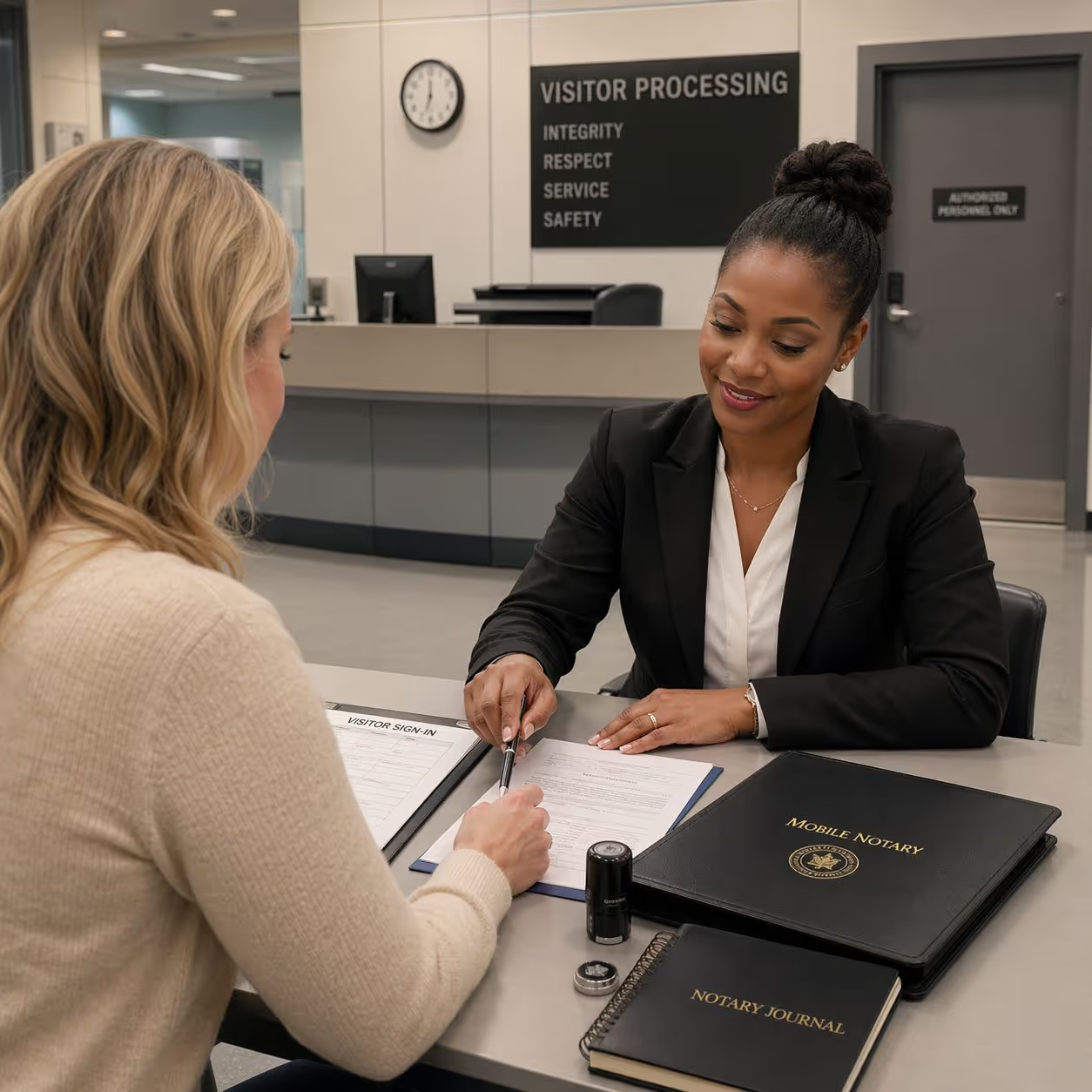
Lake Mead Mobile Notary provides mobile escrow document notarization for buyers, sellers, escrow officers, title companies, and real estate professionals across the Las Vegas Valley.
Escrow and closing packages may include final settlement statements, deeds, affidavits, loan documents, lender disclosures, escrow instructions, title commitments, and buyer or seller documents.
The notary verifies each signer's identity, completes the requested Nevada notarial acts, and follows the written execution and document-return instructions supplied with the escrow package.
Notarial Requirements
Most escrow documents do not automatically require notarization. The notary performs only the act requested by the document, escrow officer, title company, or receiving institution.
Deeds transfer property ownership and commonly contain a signature requiring an acknowledgment for recording. This is one of the most common escrow documents requiring notarization.
Deeds of trust create or confirm the lender's security interest and commonly contain a signature requiring an acknowledgment for recording. These are often part of the buyer's package.
Affidavits may include occupancy statements, identity affidavits, name affidavits, marital-status declarations, or other sworn representations requested by the title company or escrow officer. These may require notarization.
The settlement statement provides a final accounting of the transaction. It generally does not require notarization; it requires signatures acknowledging receipt.
Disclosures provide information about the transaction, property, or loan terms. They generally do not require notarization; they require signatures acknowledging receipt.
Loan documents, such as the promissory note and loan agreement, may or may not require notarization. The escrow officer, lender, or title company determines the execution requirements.
Document Package
The exact package varies by transaction type, title requirements, escrow officer procedures, and the specific closing instructions.
Provides a final accounting of the transaction, including the purchase price, loan amount, closing costs, and prorations. It generally does not require notarization.
Transfers property ownership from seller to buyer. The deed commonly contains a signature requiring an acknowledgment for recording. This is a key document in any escrow package.
Creates or confirms the lender's security interest in the property. It commonly contains a signature requiring an acknowledgment for recording.
Affidavits may include occupancy statements, identity affidavits, name affidavits, marital-status declarations, or other sworn representations requested by the title company or escrow officer.
Loan documents such as the promissory note and loan agreement may be included in the buyer's package. Notarization requirements vary.
Federal and state disclosures, including TRID disclosures, seller disclosures, and other required disclosures. These generally do not require notarization.
Escrow instructions specify the terms of the escrow and the requirements for closing. These may be signed but generally do not require notarization.
A document that commits the title company to issue a title insurance policy. This generally does not require notarization.
Disclosures related to the property and transaction, such as seller property disclosure, lead paint disclosure, and others. These generally do not require notarization.
Documents related to a 1031 exchange. These may require notarization depending on the exchange structure and the requirements of the exchange facilitator.
Transaction Types
Escrow transactions vary by transaction type and participant. The notary performs the same notarial acts regardless of the transaction type, but the document package and execution requirements may differ.
A transaction involving both buyer and seller. The escrow package includes buyer documents (loan documents, deed of trust) and seller documents (deed, seller disclosures). Notarization requirements are determined by the escrow officer and title company.
A transaction involving only the seller, such as a cash sale or seller-financed transaction. The escrow package includes the deed and seller disclosures. Notarization requirements are determined by the escrow officer and title company.
A transaction involving the borrower only, refinancing an existing loan. The escrow package includes the deed of trust, promissory note, and disclosures. Notarization requirements are determined by the lender and title company.
A transaction without lender financing. The escrow package includes the deed and seller disclosures. Notarization requirements are determined by the escrow officer and title company.
A transaction involving a newly constructed property. The escrow package may include additional documents such as builder warranties and construction disclosures.
A transaction involving a 1031 exchange. The escrow package may include exchange-related documents and assignments.
A transaction involving a transfer into or out of a trust. The escrow package may include trust certifications and other related documents.
A transaction involving the sale of property from an estate. The escrow package may include probate-related documents.
Parties & Signers
Escrow documents have specific signer requirements and authority rules. The notary does not determine signer authority; that is determined by the escrow officer, title company, and legal counsel.
The buyer signs loan documents, the deed of trust, and other buyer-specific documents. The buyer should ensure they understand the documents before signing.
The seller signs the deed, seller disclosures, and other seller-specific documents. The seller should ensure they understand the documents before signing.
In Nevada, the spouse may be required to sign certain documents, even if the spouse is not a party to the transaction, to release community property rights.
If the property is held in a trust, the trustee may sign on behalf of the trust. Documentation of the trust may be required.
If the property is owned by a corporation or LLC, a corporate officer or LLC member may sign on behalf of the entity. Documentation of authority may be required.
An attorney-in-fact may sign on behalf of a buyer or seller when properly authorized by a power of attorney. Documentation of authority may be required.
An escrow officer may sign certain documents as a witness or as the escrow agent. The escrow officer's role is limited to administrative functions.
Appointment Preparation
Have the complete escrow officer- or title-supplied package available, including all signature pages, exhibits, certificates, and written instructions. Follow those instructions regarding which pages must remain unsigned until the appointment.
Each person whose signature will be notarized must appear personally and present identification acceptable under Nevada notary requirements.
Confirm with the escrow officer, title company, or closing attorney which buyers, sellers, spouses, trustees, corporate officers, or other parties must sign the package and make sure each required signer is available.
Ensure the buyer, seller, property, and representative names are correct and that signers are signing in the correct capacity.
If the signer is acting on behalf of a trust, LLC, corporation, or other entity, have documentation of authority available (trust documents, corporate resolution, operating agreement, power of attorney, or other proof).
Provide the property address, transaction type, closing date, and any other relevant details contained in the escrow documents.
Confirm with the escrow officer, title company, or closing attorney whether the original wet-ink signature is required or whether electronic signatures and electronic notarization are acceptable.
If multiple signers are required (buyer, seller, spouses, etc.), confirm the signing order and coordinate the appointment so all required signers are available at the same time.
If the appointment is at a title company, escrow office, or lender branch, coordinate access and confirm any required security provisions in advance.
Provide any instructions concerning scanbacks, document order, shipping labels, carrier drop-off, courier delivery, or return to the escrow officer, title company, lender, or document processor.
Provide any instructions concerning closing dates, funding deadlines, recording deadlines, or other transaction-related timelines.
Mobile Appointment
The escrow officer, title company, or closing attorney identifies the specific escrow documents and determines what notarial acts, if any, are required.
The buyer, seller, escrow officer, title company, or closing attorney provides the closing timeline, signer information, and preferred meeting location, such as a title company office, escrow office, lender branch, residential property, or attorney's office.
Have the complete escrow package and acceptable identification ready. Leave pages unsigned when the written instructions or required notarial act calls for signing during the appointment.
The notary confirms each signer's identity, identifies signature, date, and initial locations according to the written instructions, and performs each requested lawful notarial act.
The completed package is checked for missed signatures, dates, initials, and incomplete notarial certificates. When required, pages may be scanned for review before the originals are returned according to the escrow officer, title company, lender, or closing attorney's instructions.
Common Questions
No. An escrow package may contain agreements, disclosures, affidavits, property documents, and instructions with different execution requirements. The notary completes a notarial certificate only for a signature requiring a notarial act; a notarial seal is not applied to every page in the package.
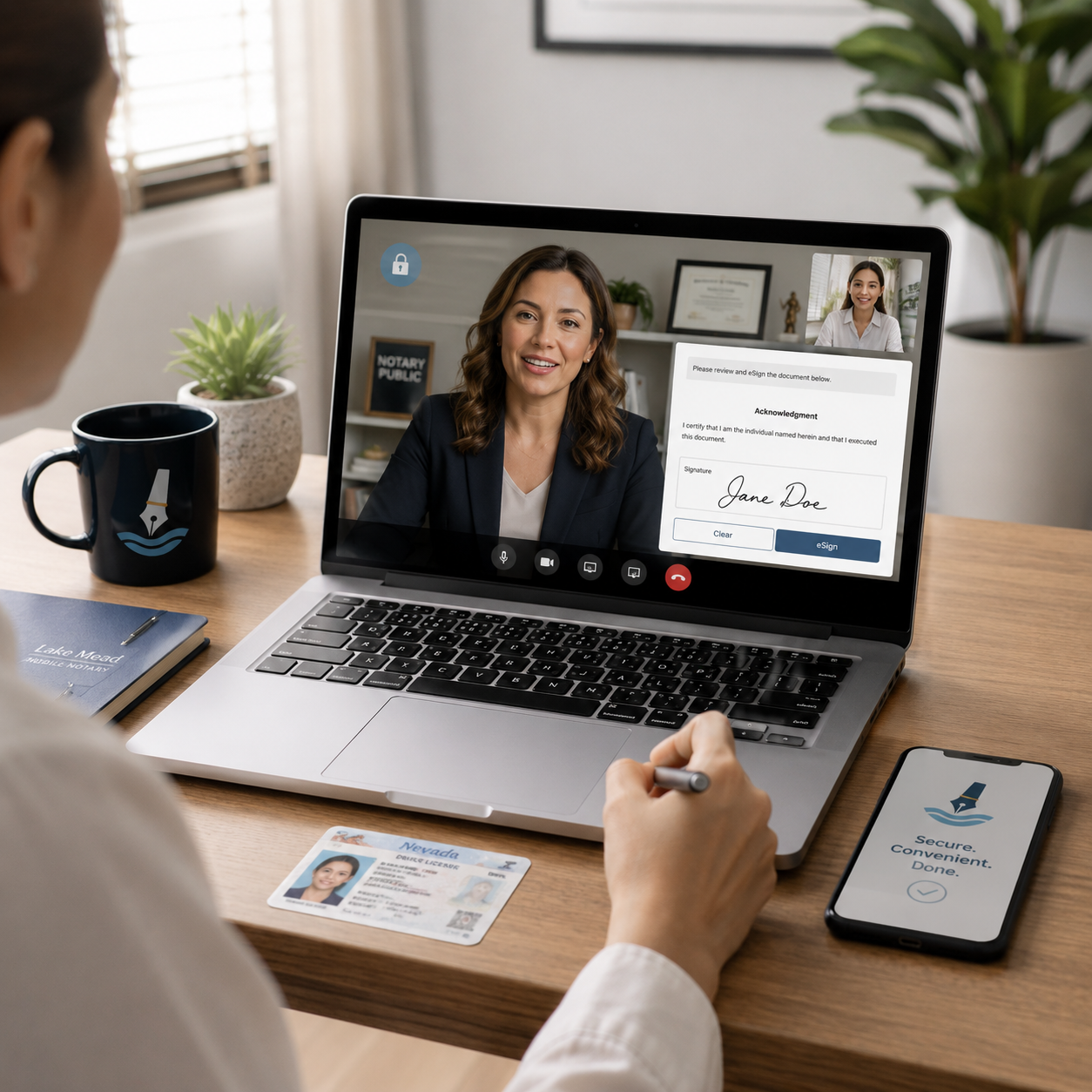
Yes, if the escrow officer, title company, and lender allow it. Nevada recognizes electronic signatures, electronic contracts, and electronic records, but the original document and the responsible recipient determine the execution format.
No. Notarization verifies identity and witnesses a signature, but it does not guarantee the escrow will close. The escrow closing is governed by the terms of the purchase contract, lender requirements, and title company policies.
No. A notarized escrow document verifies identity and witnesses the signature. The title company, escrow officer, and other receiving institutions determine whether the document meets their requirements.
No. Questions about the settlement statement, escrow instructions, title commitment, loan terms, or other provisions must be directed to the escrow officer, title company, lender, or closing attorney.
Signers should follow the escrow officer, title company, or legal counsel's written signing instructions. Do not pre-sign a document that must be signed in the notary's presence, including a document requiring a jurat. A document requiring an acknowledgment may be signed before the appointment, provided the signer personally appears and acknowledges the signature before the notary.
A buyer package includes loan documents, a deed of trust, and other documents related to the purchase and financing. A seller package includes the deed, seller disclosures, and other documents related to the sale. Notarization requirements vary.
The escrow officer oversees the escrow process, coordinates the signing, and ensures all documents are properly executed and delivered. The escrow officer is the primary contact for closing questions.
In Nevada, a spouse may be required to sign certain documents to release community property rights. The escrow officer or title company determines who must sign.
Documents related to a 1031 exchange may be part of the escrow package. The exchange facilitator and the escrow officer determine the execution requirements.
Remote online notarization (RON) may be available for some escrow documents, depending on the escrow officer's and title company's policies. Eligibility depends on the document type and the receiving institution's requirements.
Yes, when scanback, shipping, courier, carrier drop-off, or office-delivery instructions are included with the order. The required return method should be confirmed before the appointment so the original documents can be handled according to the applicable deadline.
The notary's role is to perform requested lawful notarial acts and return documents according to instructions. Questions about escrow closing, funding, recording, or post-closing matters should be directed to the escrow officer, title company, or closing attorney.
Yes. Cash transactions may still require notarization for deeds and other documents that are recorded with the county. The escrow officer or title company determines the notarization requirements.
If a signer cannot be present, a power of attorney may be an option, subject to the escrow officer's and title company's approval. Alternatively, separate signing appointments may be arranged.














.avif)


